
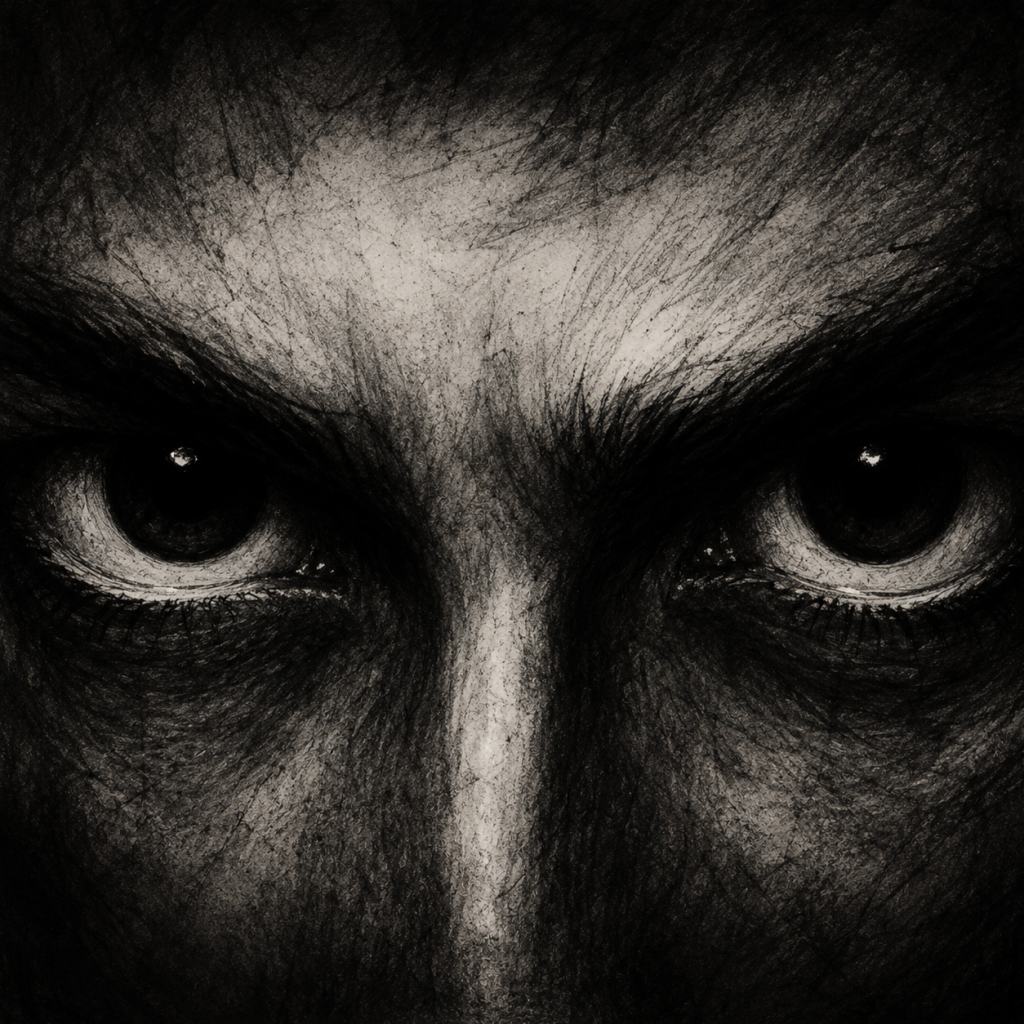
I have encountered this scenario repeatedly throughout my career: someone becomes convinced that another person’s eyes visibly “changed,” “went black,” or “went dark.” What surprises me is how often this experience becomes interpreted as evidence of a supernatural or spiritual force.
I have worked with individuals in abusive relationships whose partners describe themselves as spiritually special, chosen, enlightened, or uniquely connected to some higher power. Over time, the abusive partner creates a framework where leaving the relationship begins to feel dangerous—not just emotionally, but spiritually. The thinking slowly becomes: “What if they really are chosen? What if leaving them means I’m turning my back on something sacred?”
Sometimes this evolves into statements such as:
- “God chose me.”
- “You were meant to help me.”
- “If you abandon me, you are abandoning God’s plan.”
In therapy, I rarely tell people their experiences are “wrong.” However, I have had multiple individuals sincerely describe moments where their abusive partner’s eyes appeared to “turn dark,” and they interpreted that change as possession, spiritual warfare, or an outside force taking over. In many of these cases, the abusive behavior—hitting, cheating, manipulation, sexual violence, or cruelty—was later excused as something caused by “external forces” rather than the individual themselves.
This creates a psychologically powerful escape hatch:
The person hurting me is still good. Something else caused the harm.
That belief can become emotionally protective because it helps preserve attachment to the person while also trying to make sense of the abuse.
This dynamic is not uncommon in cult environments either. Many abusive individuals and cult leaders follow similar patterns:
- intense love bombing
- excessive praise or gifts
- making the victim feel uniquely special
- gradually creating guilt and obligation
- isolating the person from supportive relationships
- encouraging emotional or financial dependence
Over time, invisible psychological cages begin to form:
- “You’re betraying me.”
- “You’re betraying God.”
- “Nobody else understands me like you do.”
- “You were chosen to help me.”
The goal is often the same: to make leaving feel morally wrong, spiritually dangerous, or emotionally impossible.
I think human beings naturally try to normalize and justify the environments they live in. We all do this to varying degrees. Our minds constantly attempt to create meaning, especially in painful or confusing situations.
That brings me back to the experience of someone’s eyes “going dark.”
When people describe this phenomenon, they are often observing a very real physiological and psychological shift. During intense anger, fear, aggression, or adrenaline activation, the body enters a fight-or-flight state. Pupils can dilate, making the eyes appear darker—especially in low lighting. At the same time, facial muscles tighten, blinking decreases, staring becomes more fixed, and emotional expression may flatten or harden. Humans are highly sensitive to threat cues, so the brain interprets these combined changes as the person suddenly seeming more dangerous, emotionally absent, or “different.”
In other words, the experience feels real because something is changing. But that does not necessarily mean something supernatural is occurring.
To be clear, I have nothing against spirituality or religion. For many people, both can provide meaning, hope, community, and healing. The concern arises when spiritual ideas are used as tools for manipulation, control, fear, or justification for abuse.
What saddens me is how easily false beliefs can become fused with identity. Once that happens, people may resist evidence, logic, or even direct harm because accepting reality would require dismantling the belief system holding everything together.
Imagine someone becoming convinced that food is poisonous. Everyone around them—friends, doctors, science—keeps telling them they need nutrition to survive. Yet they remain absolutely certain the world is wrong and that eating will harm them. Eventually, that person becomes very sick, not because reality failed them, but because their beliefs prevented them from responding to reality accurately.
Our beliefs shape how we interpret the world. Sometimes they protect us. Sometimes they trap us.
So why do human beings hold onto false beliefs, even when those beliefs harm them?
That will likely be the subject of my next article.
Leave a Reply