
One of the things people notice about me is that I tend to use playfulness in situations where most people wouldn’t.
I’ve used it while working psychiatric crises, during suicide interventions, in therapy sessions, and even while performing magic. There’s something strangely powerful about play. It interrupts expectation. It lowers defenses. It reminds people—even if only for a moment—that they aren’t trapped inside whatever emotion they’re currently feeling.
Not every memorable moment, however, has been life or death.
One happened while I was walking to perform at House of Cards in downtown Nashville.
Like many cities, Nashville has a large homeless population. Some people living on the streets lie, manipulate, or steal in order to meet their basic needs. Years ago, that probably would have frustrated me. Today, it rarely does.
Not because I approve of hurting others.
But because I’ve spent decades trying to understand why people do what they do.
Over twenty years ago, I stumbled across an idea from Aristotle that quietly changed how I viewed humanity. In Nicomachean Ethics, he begins by arguing that every deliberate action aims at some perceived good. In other words, people generally act toward what they believe—rightly or wrongly—will improve their situation.
That doesn’t make every action moral.
It doesn’t excuse cruelty.
But it does suggest something profound: even destructive behavior often makes sense from inside the mind of the person committing it.
That single idea planted a seed that has continued to grow for more than twenty years.
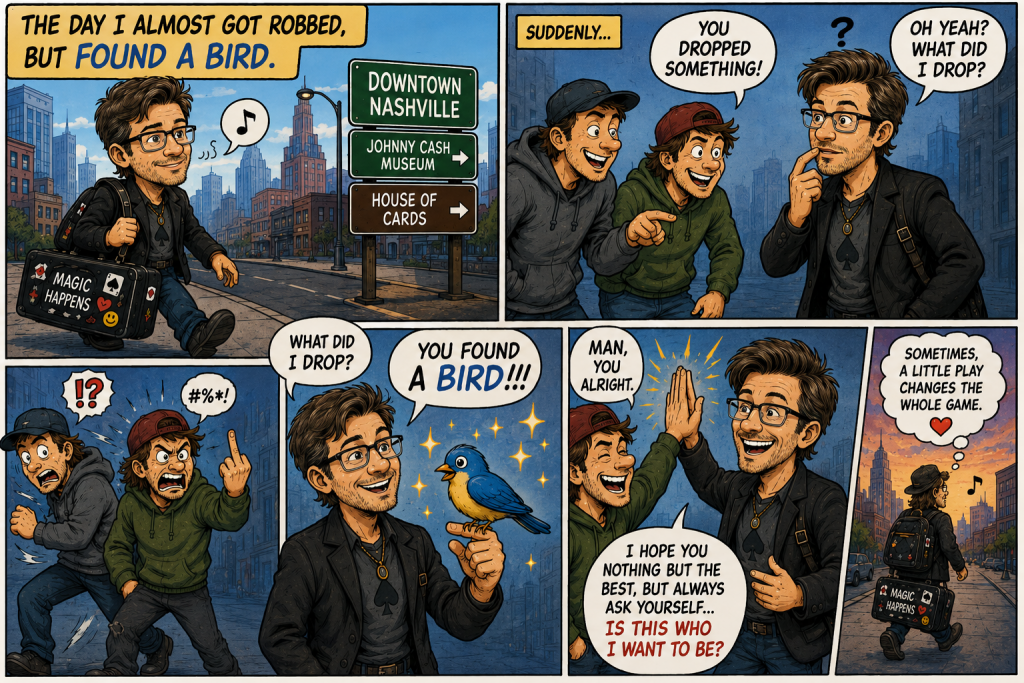
One evening, I was walking from the Pinnacle parking garage toward the Johnny Cash Museum on my way to perform.
Two young men—probably in their early twenties—hurried toward me.
“You dropped something,” one of them called.
Fortunately, I already knew the scam. The goal is to get someone to stop, look down, become distracted, and then steal whatever they can.
Most people instinctively accept statements like that as true. We hear, “You dropped something,” and our brain immediately starts searching for what we lost.
Instead of looking down, I simply paused and asked,
“What did I drop?”
Everything froze.
Their script had been interrupted.
One of the men immediately walked away. The other became visibly angry and raised his hand, extending only his middle finger.
Then something unexpected happened.
I smiled as big as I could and excitedly said,
“You found a bird!”
He couldn’t keep the anger on his face.
He burst out laughing.
His shoulders relaxed.
He gave me a high five and said,
“Man… you alright.”
I looked him in the eye and replied,
“I hope nothing but the best for you. But always ask yourself… is this who you want to be?”
Then I patted him on the shoulder and continued on to my show.
I’ll probably never see him again.
But I think about him sometimes.
Our lives intersect with thousands of people whose stories we’ll never know. Most interactions last only seconds. Yet we have no idea which moments become someone’s turning point.
Sometimes we leave people a little more angry.
Sometimes a little more hopeful.
Sometimes we simply remind them they’re still capable of laughing.
I wonder how often our energy changes someone else’s direction without either of us ever realizing it.
I often imagine what humanity might look like if every person’s basic needs were met from the very beginning.
Would people still steal?
Would manipulation still exist?
Probably.
But I suspect we’d see much less of it.
Human beings evolved to survive. We are wired to protect ourselves, but we’re also wired for connection and cooperation. Which side shows up often depends on the environment around us.
When survival dominates our attention, our world becomes very small.
Me.
Mine.
Today.
When people finally feel safe, their attention often expands beyond themselves.
They begin thinking about family.
Community.
Legacy.
The future.
For years I wrestled with a simple question:
Why are some people “good” while others are “bad”?
Black-and-white thinking is incredibly appealing. It simplifies the world and saves mental energy.
Reality seems much messier.
What if every one of us carries the capacity for extraordinary kindness and extraordinary cruelty?
What if our actions are constantly shaped by the interaction between our biology, our experiences, our environment, and the story we’re telling ourselves in that moment?
If Aristotle is even partially right, then most people aren’t trying to become villains.
They’re trying to move toward what they believe is “good”—even when they’re tragically mistaken about what that is.
That perspective doesn’t remove responsibility.
It increases compassion.
This is where I find game theory fascinating.
One idea from game theory—the Nash Equilibrium—suggests that stable outcomes emerge when individuals make choices while considering the likely choices of everyone else.
I don’t think human relationships can be reduced to mathematics.
But I do think the analogy is useful.
Healthy societies emerge when our individual pursuit of “good” begins to account for the well-being of those around us.
The moment my good depends on your suffering, something has gone wrong.
The moment my good is strengthened by your flourishing, we’re moving toward something much healthier.
Maybe that’s why I keep returning to play.
Play interrupts conflict.
It breaks rigid thinking.
It creates connection where confrontation usually lives.
Sometimes all it takes is one unexpected sentence—
“You found a bird.”
Not because the joke solved anything.
But because, for one brief moment, two people stopped seeing each other as enemies.
And sometimes…
that’s enough to remind us that we’re all far more connected than we realize.

Leave a Reply