
I have the same dream over and over again.
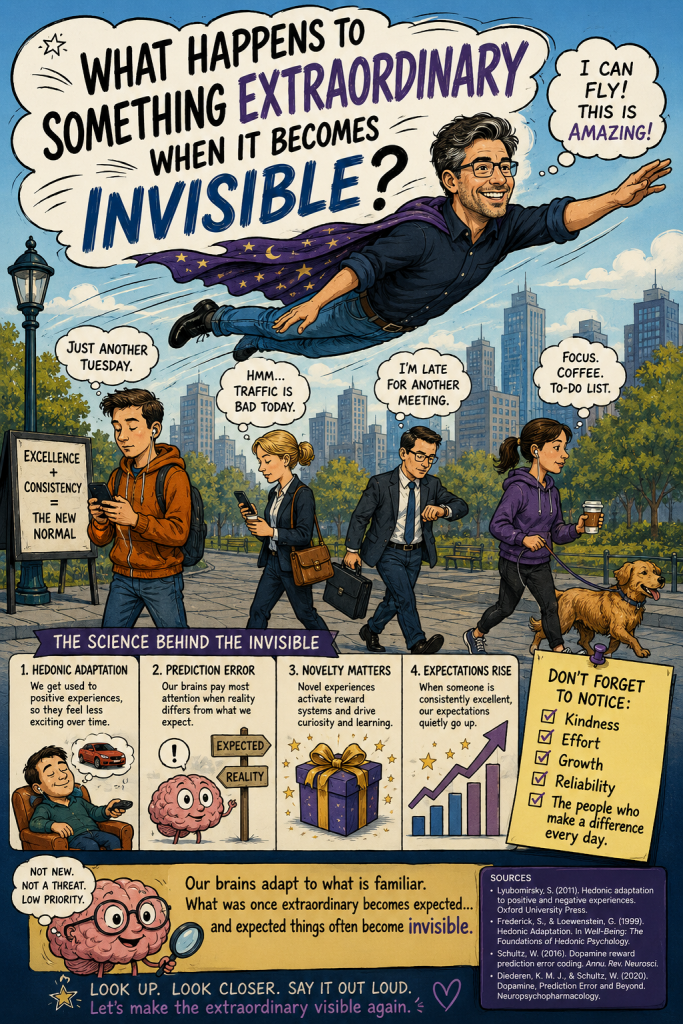
In it, I can fly.
Not for a few seconds. Not in the awkward “I’m falling with style” kind of way. I can actually control it. I soar over trees, neighborhoods, and buildings as naturally as someone riding a bicycle.
There’s just one problem.
No one seems impressed.
People continue walking. Some barely look up. Others act as if flying is the most ordinary thing in the world.
I’ve always found that part of the dream fascinating.
Not because I think dreams predict the future, but because they often reveal interesting emotional questions. In this case, the question isn’t, “Why can I fly?”
It’s…
What happens when something extraordinary becomes ordinary?
As it turns out, psychology has quite a bit to say about that.
The Brain is Built to Ignore Familiar Things
Our brains are prediction machines.
Rather than paying equal attention to everything around us, the brain constantly asks one question:
“What’s new?”
Novel things demand attention because they might represent opportunity…or danger.
Familiar things?
The brain gradually spends less energy noticing them.
Imagine you buy your dream car. The first week, you look back at it every time you park. Six months later, it’s just…your car.
That isn’t because the car became less beautiful.
It’s because your brain became more efficient.
Psychologists call this hedonic adaptation—our tendency to become accustomed to positive (and negative) experiences over time, reducing their emotional impact. It’s one reason new achievements, promotions, possessions, and even major life milestones often feel less remarkable as time passes. (Wikipedia)
We Adapt to People, Too
Here’s the part that surprised me.
We don’t just adapt to objects.
We adapt to people.
If your friend runs a marathon once, everyone celebrates.
If they run twenty marathons?
People begin saying, “Well…that’s just what they do.”
The achievement didn’t become smaller.
It became expected.
In psychology, expectations strongly shape our emotional responses. When reality consistently matches our expectations, our brains devote less attention to it. The surprise disappears, even when the accomplishment remains objectively impressive. (Wikipedia)
Excellence Has a Strange Side Effect
Consistency is one of the highest compliments a professional can receive.
You want your surgeon to be consistently excellent.
Your pilot.
Your therapist.
Your favorite restaurant.
Your electrician.
Ironically, consistency is also one of the fastest ways to become overlooked.
The first time someone exceeds expectations, we applaud.
The twentieth time?
We often stop noticing.
Not because excellence disappeared.
Because excellence became the expectation.
The Invisible Cost
This creates an interesting psychological trap.
Imagine someone who has worked incredibly hard to develop a skill.
They continue growing.
Continue improving.
Continue showing up.
But the people around them have unconsciously adjusted their expectations upward.
Instead of hearing, “Wow!”
They hear…
“Looks good.”
“Nice job.”
Or perhaps nothing at all.
That silence can easily be misinterpreted as a lack of appreciation, when in reality it may simply be a consequence of familiarity.
There’s a Lesson Here for Relationships
This doesn’t just happen with careers or accomplishments.
It happens inside marriages.
Families.
Friendships.
Workplaces.
We stop noticing the spouse who quietly makes life easier every day.
The coworker who never drops the ball.
The parent who consistently shows up.
The friend who always answers the phone.
Reliability slowly becomes invisible.
And yet, those are often the people holding everything together.
So What Do We Do?
First, recognize that familiarity changes perception.
If someone doesn’t react with amazement, it doesn’t automatically mean your efforts lack value.
Second, practice noticing the extraordinary in the people you’ve known the longest.
Thank the dependable coworker.
Compliment the spouse whose kindness has become routine.
Tell your friend why you admire them—not because they did something new, but because they’ve been doing something remarkable all along.
Finally, ask yourself one important question.
Have I stopped noticing my own growth because it has become familiar?
Maybe you’ve become calmer.
Kinder.
Healthier.
More patient.
More resilient.
Maybe you’ve learned to “fly” in ways that no longer feel unusual because you’ve lived with them for so long.
That doesn’t make them ordinary.
It simply means you’ve forgotten how extraordinary they once seemed.
Perhaps that’s what my dream has been asking all these years.
Not, “Why isn’t anyone impressed?”
But rather…
What extraordinary things have become so familiar that we’ve stopped looking up?

Leave a Reply