
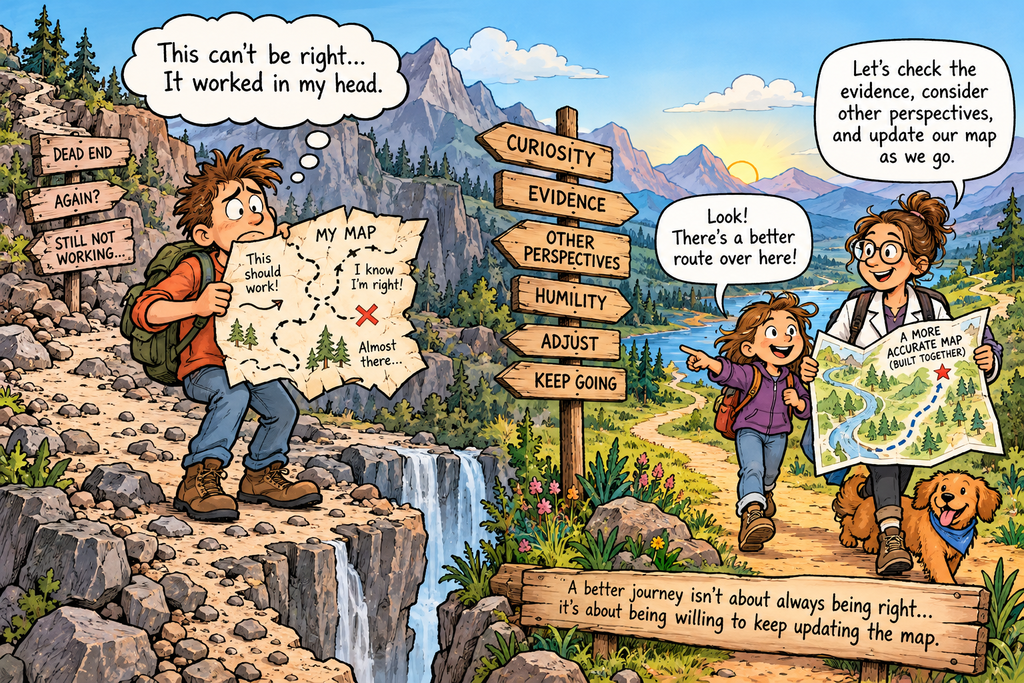
The psychology of self-deception, false beliefs, and the maps we use to navigate life
I’ve been thinking a lot lately about why people avoid the truth.
It’s a fascinating question because it applies to so many different situations. Relationships, politics, friendships, professional environments, and even the conversations we have with ourselves.
Have you ever encountered someone who was absolutely convinced something was true, despite evidence suggesting otherwise? Perhaps you’ve presented facts, offered alternative explanations, or even shown direct evidence, only to watch that person dig their heels in further.
Sometimes, the more evidence you provide, the more convinced they become that they’re right.
Why?
As a therapist, I’ve spent years exploring how people think, how they interpret their experiences, and how their beliefs influence their behavior. One thing I’ve come to appreciate is that our relationship with the truth is far more complicated than simply knowing what is right or wrong.
In fact, psychological research suggests that our minds aren’t always interested in discovering what is true. Sometimes, they’re more interested in protecting what we already believe.
And that distinction matters.
When a Belief Becomes Part of Who We Are
One of the most interesting explanations comes from a psychological phenomenon called motivated reasoning.
Psychologist Ziva Kunda explored this concept in a landmark 1990 paper, demonstrating how our motivations can influence the way we gather information, evaluate evidence, and arrive at conclusions.
In other words, we don’t always examine information objectively and then decide what to believe. Sometimes, we begin with the conclusion we want to reach and work backward to justify it.
This becomes particularly powerful when a belief is connected to our identity.
Think about it.
If someone challenges your opinion about a restaurant, it’s probably not going to be particularly upsetting.
But what if someone challenges something you’ve built your identity around? Your political beliefs, your profession, your accomplishments, your understanding of your relationships, or even your belief that you’re a good person?
Suddenly, the conversation isn’t simply about whether something is true.
It can feel like a challenge to who you are.
In a fascinating series of studies published in 2003, psychologist Geoffrey Cohen demonstrated just how powerful group identity can become. Participants’ evaluations of proposed political policies were strongly influenced by which political party supposedly supported those policies, sometimes outweighing the actual content of the proposal.
Perhaps more interestingly, participants generally didn’t recognize how much their group affiliation had influenced their judgments.
They believed they were thinking independently.
That’s the really fascinating part. We can genuinely believe we’re being objective while our thinking is being influenced by forces we don’t recognize.
The Map Is Not the Territory
When I was in graduate school, we discussed a concept that has stayed with me throughout my career.
Imagine that every person navigates life using a map.
This map is built over time through our experiences, relationships, education, upbringing, successes, failures, and interpretations of the world around us.
The problem?
Our map of the world is not necessarily an accurate representation of the world itself.
Imagine trying to navigate across the country using a map you’ve drawn yourself. You’ve included the roads you believe exist, the landmarks you remember, and the routes you’re convinced will take you where you want to go.
But what happens when your map is wrong?
You take a road expecting it to lead somewhere, only to discover a dead end.
You become frustrated.
You try again.
Another dead end.
Eventually, you might become convinced that the problem isn’t your map. It’s the roads themselves.
You might even get angry at someone who suggests your map is inaccurate.
This is something I see in human behavior regularly.
People develop expectations about how the world works, how others should behave, and what certain experiences mean. When reality doesn’t match those expectations, they experience frustration, disappointment, anger, or confusion.
Sometimes, instead of adjusting their understanding, they attempt to force reality to conform to their expectations.
Psychology offers a name for some of the discomfort associated with these contradictions: cognitive dissonance.
Cognitive dissonance occurs when our beliefs, attitudes, or behaviors conflict with one another, creating psychological discomfort.
One way to resolve that discomfort is to reconsider our beliefs.
Another is to reinterpret, minimize, or rationalize the contradictory information.
The second option may feel easier in the moment.
Unfortunately, it doesn’t necessarily make our map any more accurate.
The Lies We Tell Ourselves
Here’s another uncomfortable thought.
You probably trust your own thinking more than you realize.
After all, you’re the person experiencing your thoughts. You know your intentions, your memories, your feelings, and the explanations you’ve developed for your decisions.
Surely, you would know if you were misleading yourself.
Right?
Not necessarily.
Psychological research has repeatedly demonstrated that people can be remarkably unaware of the biases influencing their own thinking.
One particularly relevant phenomenon is confirmation bias.
Confirmation bias describes our tendency to seek, interpret, and remember information in ways that support beliefs we already hold.
In a classic 1979 study, researchers Charles Lord, Lee Ross, and Mark Lepper examined how people with opposing views on capital punishment evaluated research about its effectiveness.
Both groups reviewed studies presenting conflicting conclusions.
Rather than simply moving toward agreement, participants tended to evaluate evidence supporting their existing position more favorably.
The very same exercise led people on opposite sides to become more confident in their original views.
Think about how remarkable that is.
Two people can encounter similar information and walk away believing it proves entirely different things.
And both can feel completely justified.
This is why I find the phrase “I know what I know” so interesting.
Sometimes, what we actually mean is, “I have become so comfortable with this explanation that I no longer feel a need to question it.”
And that’s a dangerous place for our thinking to settle.
Because confidence and accuracy are not the same thing.
We’re All the Heroes of Our Own Stories
There’s another psychological tendency that I find particularly interesting.
Most of us want to believe we’re good people.
We want to believe our decisions are reasonable, our intentions are honorable, and our mistakes are understandable.
Psychologists refer to one related tendency as the self-serving bias.
A large meta-analysis published in 2004 examined 266 studies and found substantial evidence that people commonly explain positive outcomes through their own abilities or actions while attributing negative outcomes to external circumstances.
For example:
When we succeed, it may be because we worked hard.
When we fail, it may be because the circumstances were unfair.
When someone else makes a mistake, perhaps they’re irresponsible.
When we make the same mistake, perhaps we were overwhelmed, misunderstood, or dealing with circumstances beyond our control.
Of course, sometimes those explanations are accurate.
The problem arises when we consistently apply one standard to ourselves and another to everyone else.
We become the sympathetic protagonist of our own story, with access to every explanation for our behavior, while other people are judged primarily by what we can see.
This can become especially destructive in relationships.
Imagine two people having an argument.
Both believe they were wronged.
Both can describe the other’s behavior in detail.
Both can justify their own reactions.
And both may be so focused on defending their interpretation that neither is genuinely examining their contribution to the conflict.
Have you ever tried discussing something with someone, only to have every point met with:
“Yeah, but…”
Now, to be fair, those two words don’t automatically mean someone is being defensive. Sometimes there’s a legitimate objection.
But sometimes what follows is an attempt to preserve the original belief rather than consider the new information.
The goalposts move.
The explanation changes.
The evidence required becomes increasingly difficult to satisfy.
And the conversation stops being about discovering what happened.
It becomes about protecting the person’s version of what happened.
Here’s the part that’s easy to miss.
We all have the capacity to do this.
Including me.
Including you.
Recognizing that doesn’t mean we should distrust every thought we have. It means we should develop enough humility to recognize that believing something strongly doesn’t automatically make it true.
What Children and Scientists Can Teach Us
So how do we improve our maps?
I think we can learn something valuable from two groups: children and scientists.
Now, I want to be careful here. Children aren’t automatically better at evaluating evidence, and scientists certainly aren’t immune to cognitive biases.
But there are qualities associated with curiosity and scientific investigation that I believe we could all benefit from practicing.
Children are constantly developing explanations for how the world works.
They ask questions.
They experiment.
They encounter experiences that challenge their expectations.
And sometimes, they change their minds.
Research by Katherine Kimura and Alison Gopnik, published in 2019, found that children as young as four and five could revise previously held beliefs when presented with sufficiently strong contradictory evidence.
Interestingly, children were also more resistant to changing beliefs when those beliefs were strongly supported.
Sound familiar?
The important lesson isn’t that children always think more accurately.
It’s that learning requires the ability to update our understanding.
Science, at its best, operates on a similar principle.
A scientist develops a hypothesis, gathers evidence, tests predictions, and examines whether the findings support the original explanation.
Other researchers attempt to reproduce those findings.
If evidence consistently contradicts a hypothesis, the explanation may need to change.
And that’s not a failure of science.
That’s one of its greatest strengths.
Of course, individual scientists can become attached to their theories, too. Research can be flawed, findings can fail to replicate, and entire fields can discover that previously accepted explanations were incomplete.
But this is precisely why independent testing, replication, transparency, and ongoing scrutiny matter.
The scientific process provides ways to challenge our personal assumptions rather than relying entirely upon them.
Imagine applying that approach to everyday life.
Instead of asking, “How can I prove I’m right?”
What if we asked, “What evidence would convince me I’m wrong?”
That’s a very different question.
And one that can be remarkably difficult to answer.
Learning to Redraw Our Maps
Let’s return to the map analogy.
Imagine you’re trying to reach a destination you’ve never visited.
You could insist upon using your hand-drawn map, even though you’ve repeatedly encountered roads that don’t exist and turns that lead nowhere.
Or you could compare your map with reliable information gathered, tested, and corrected by others.
You could examine the actual terrain.
You could ask people who have traveled the route.
And when you discover something inaccurate, you could update your map.
Would that guarantee a perfect journey?
Of course not.
There will still be unexpected obstacles, road closures, bad weather, and situations beyond your control.
But your chances of reaching your destination improve when your decisions are informed by an accurate understanding of the environment.
I think our psychological lives work similarly.
When we become willing to question our beliefs, seek outside perspectives, acknowledge mistakes, and incorporate new evidence, we create opportunities for personal growth.
Research on intellectual open-mindedness offers some support for this. A 2015 study examining geopolitical forecasting found that more accurate forecasters tended to demonstrate greater cognitive flexibility, open-mindedness, and willingness to update their beliefs.
In other words, being willing to reconsider a conclusion can be a strength rather than a weakness.
And for those of us who struggle with admitting mistakes, there’s another encouraging finding.
Research on self-affirmation suggests that reminding ourselves of our broader values and sense of worth can sometimes reduce defensiveness when we encounter uncomfortable information.
Perhaps that’s because acknowledging a mistake doesn’t have to mean rejecting our entire identity.
You can be a good person who made a bad decision.
You can be intelligent and still be wrong.
You can have good intentions and still hurt someone.
And you can acknowledge that your understanding was inaccurate without surrendering your dignity.
Those aren’t contradictions.
They’re part of being human.
Maybe the Goal Isn’t to Be Right
One of the ironic things about human behavior is how frequently we make our own journeys more difficult.
We cling to explanations that aren’t working.
We defend positions that no longer fit the available evidence.
We refuse to ask for directions because admitting we’re lost feels uncomfortable.
And sometimes, we spend so much energy protecting our beliefs that we never stop to consider whether those beliefs are helping us get where we want to go.
As a therapist, I don’t believe personal growth comes from always having the correct answer.
I believe it comes from developing the willingness to examine our answers.
To ask difficult questions.
To recognize when emotion is influencing interpretation.
To consider perspectives that make us uncomfortable.
And perhaps most importantly, to recognize that being wrong about something doesn’t make us a failure.
It makes us human.
So here’s a question I’d encourage you to consider:
What is something you believe so strongly that you would have difficulty accepting evidence to the contrary?
And perhaps a more important question:
What would it take for you to change your mind?
Because maybe the goal in life shouldn’t be to prove that our map has always been right.
Maybe the goal should be to keep improving the map.
Just something to think about.
Research and Further Reading
- Kunda, Z. (1990). The case for motivated reasoning. Psychological Bulletin, 108(3), 480–498. Read study
- Cohen, G. L. (2003). Party over policy: The dominating impact of group influence on political beliefs. Journal of Personality and Social Psychology, 85(5), 808–822. Read study
- Lord, C. G., Ross, L., & Lepper, M. R. (1979). Biased assimilation and attitude polarization: The effects of prior theories on subsequently considered evidence. Journal of Personality and Social Psychology, 37(11), 2098–2109. Read study
- Festinger, L., & Carlsmith, J. M. (1959). Cognitive consequences of forced compliance. Journal of Abnormal and Social Psychology, 58(2), 203–210. Read study
- Mezulis, A. H., Abramson, L. Y., Hyde, J. S., & Hankin, B. L. (2004). Is there a universal positivity bias in attributions? Psychological Bulletin, 130(5), 711–747. Read study
- Kimura, K., & Gopnik, A. (2019). Rational higher-order belief revision in young children. Child Development, 90(1), 91–97. Read study
- Mellers, B., et al. (2015). The psychology of intelligence analysis: Drivers of prediction accuracy in world politics. Journal of Experimental Psychology: Applied, 21(1), 1–14. Read study
- Epton, T., et al. (2015). The impact of self-affirmation on health-behavior change: A meta-analysis. Health Psychology. Read study
- Open Science Collaboration (2015). Estimating the reproducibility of psychological science. Science, 349(6251). Read study
Leave a Reply