
One of the questions that has fascinated me for years is this:
Why do humans keep creating the same stories?
Not similar stories.
The same stories.
Across continents.
Across languages.
Across thousands of years.
Long before the internet, telephones, airplanes, or even reliable maps, cultures separated by oceans repeatedly developed remarkably similar symbols, myths, and themes.
Flood stories appear throughout the world.
Heroes leave home, face trials, and return transformed.
Dragons, serpents, and monsters emerge again and again.
Wise elders guide younger generations.
Stories of death and rebirth repeat themselves throughout history.
The details change, but the patterns remain.
Why?
How is it possible that people who never met each other, spoke different languages, and lived in entirely different environments often arrived at similar explanations for the world around them?
One possibility is that these similarities reveal something important about the human mind itself.
Perhaps we are far more alike than we realize.
Perhaps when human beings encounter uncertainty, danger, love, loss, growth, or the mysteries of nature, our minds naturally organize those experiences in similar ways.
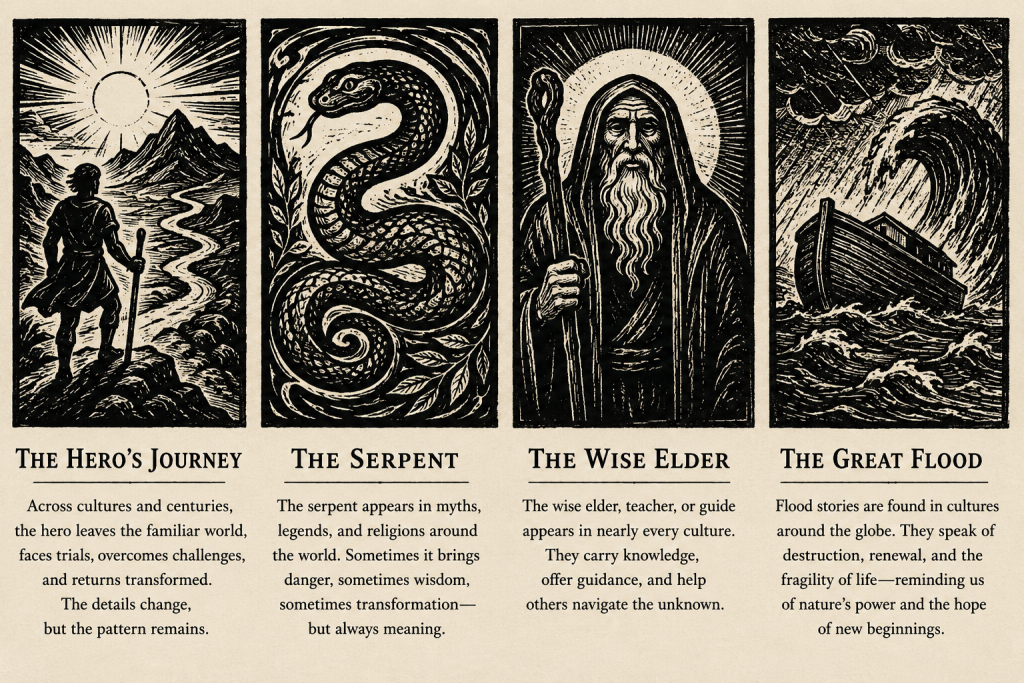
The Great Flood
Flood stories appear in cultures across the globe.
Ancient Mesopotamian civilizations told stories of devastating floods. Similar accounts appear in Biblical traditions, Hindu traditions, Chinese folklore, and numerous Indigenous cultures.
Does this mean every flood story is describing the exact same event?
Perhaps not.
But it does suggest something interesting.
Most early civilizations formed near water because water meant survival. Rivers provided transportation, food, irrigation, and trade.
Unfortunately, they also flooded.
A flood was one of the most overwhelming and destructive events ancient people could experience. Entire communities could be changed overnight.
It makes sense that such an experience would become embedded in stories, legends, and collective memory.
The Hero’s Journey
Another pattern appears repeatedly throughout human history.
A person leaves the familiar world.
They encounter challenges.
They struggle.
They change.
They return transformed.
Whether we are talking about Gilgamesh, Hercules, Moses, Buddha, King Arthur, or modern fictional characters such as Luke Skywalker, the pattern remains surprisingly consistent.
Why?
Perhaps because growth itself often follows this structure.
Most meaningful change requires leaving what is comfortable, facing uncertainty, and returning with new knowledge.
The story resonates because many of us have lived versions of it ourselves.
The Wise Elder
Across cultures we repeatedly encounter some version of the wise guide.
The shaman.
The wizard.
The prophet.
The mentor.
The grandparent.
The teacher.
Nearly every society develops stories about individuals who possess knowledge and help others navigate uncertainty.
This may be because knowledge has always had survival value. Learning from someone else’s experience is often less costly than learning entirely through trial and error.
The symbol survives because the need survives.
The Serpent
Perhaps one of the most fascinating recurring symbols is the serpent.
Serpents appear throughout mythology, religion, folklore, and art.
Sometimes they represent danger.
Sometimes wisdom.
Sometimes transformation.
Sometimes both.
Researchers have suggested that humans evolved specialized abilities to rapidly detect snakes because they represented a genuine threat throughout much of our evolutionary history.
If true, this would mean the serpent became symbolically important because it was biologically important first.
The mind assigned meaning to something it needed to notice.
Why Do These Patterns Keep Appearing?
Perhaps the better question is this:
Why does the human mind search for explanations at all?
Imagine hearing a crack of thunder thousands of years ago.
Today we understand thunder as the result of lightning rapidly heating the surrounding air, creating a shockwave that travels through the atmosphere.
But for most of human history, people didn’t know that.
What they did know was that something powerful had happened.
So they created explanations.
Perhaps a god was angry.
Perhaps a spirit was speaking.
Perhaps it was a warning.
While those explanations may not have been scientifically accurate, they served an important purpose.
They reduced uncertainty.
And humans appear to dislike uncertainty.
From an evolutionary perspective, uncertainty can be dangerous.
Imagine hearing movement in nearby bushes.
There are two possibilities:
- It’s the wind.
- It’s a predator.
If you assume predator and you’re wrong, you lose a little energy.
If you assume wind and you’re wrong, you may lose your life.
Over thousands of generations, it makes sense that human beings evolved to search for patterns, causes, and explanations as quickly as possible.
Sometimes even before all the information is available.
The Stories We Tell Ourselves
What’s particularly interesting is that this tendency didn’t disappear when science arrived.
We still search for explanations constantly.
When a relationship ends, we search for reasons.
When we lose a job, we search for reasons.
When we experience anxiety, depression, anger, grief, or fear, we search for reasons.
The human mind seems uncomfortable with unanswered questions.
As a therapist, I’ve noticed something else.
Different people often arrive at remarkably similar conclusions.
Different ages.
Different backgrounds.
Different experiences.
Yet many tell themselves similar stories:
“I’m not good enough.”
“I’m a burden.”
“Nobody understands me.”
“Things will never get better.”
“I’m stuck.”
These explanations can become so familiar that they begin to feel like facts.
But what if they are simply the first explanation the mind found?
What if the explanation that reduced uncertainty wasn’t necessarily the most complete explanation available?
Looking for Patterns
The more I study psychology, mythology, neuroscience, and human behavior, the more interested I become in patterns.
Not just patterns across cultures.
Patterns across people.
The symbols, stories, and myths of humanity suggest that human beings may be more interconnected than we realize.
Separated by time, geography, language, and culture, we still seem to organize many experiences in surprisingly similar ways.
If these themes truly are patterns, then perhaps they can be understood.
And if they can be understood, perhaps they can be predicted.
We routinely predict weather patterns because we understand the forces that create them. We can predict eclipses, tides, seasons, and even many diseases because we’ve spent centuries identifying the variables involved.
What if some aspects of human behavior operate similarly?
Not in a way that removes individuality or reduces people to numbers, but in a way that helps us better understand the common forces influencing our decisions, emotions, and relationships.
As a therapist, I’ve become increasingly interested in the possibility that beneath the complexity of every person’s story lie a number of recurring variables—patterns that appear over and over again regardless of age, background, culture, or circumstance.
If those patterns exist, understanding them may offer more than insight.
It may offer options.
Because once we understand the factors influencing an outcome, we gain the ability to influence the outcome itself.
Perhaps the most valuable question is not whether patterns exist.
The symbols, myths, and stories of humanity suggest they do.
The more interesting question may be:
What happens when we begin to understand the mechanisms behind them?
Leave a Reply