
Most people like to think they are rational. We imagine that when presented with enough evidence, we will simply adjust our beliefs and move forward. Yet history, politics, religion, science, and even our personal relationships repeatedly demonstrate that this is often not how human beings operate.
In fact, some of the strongest resistance to change occurs not when a belief is supported by evidence, but when that belief becomes tied to a person’s identity.
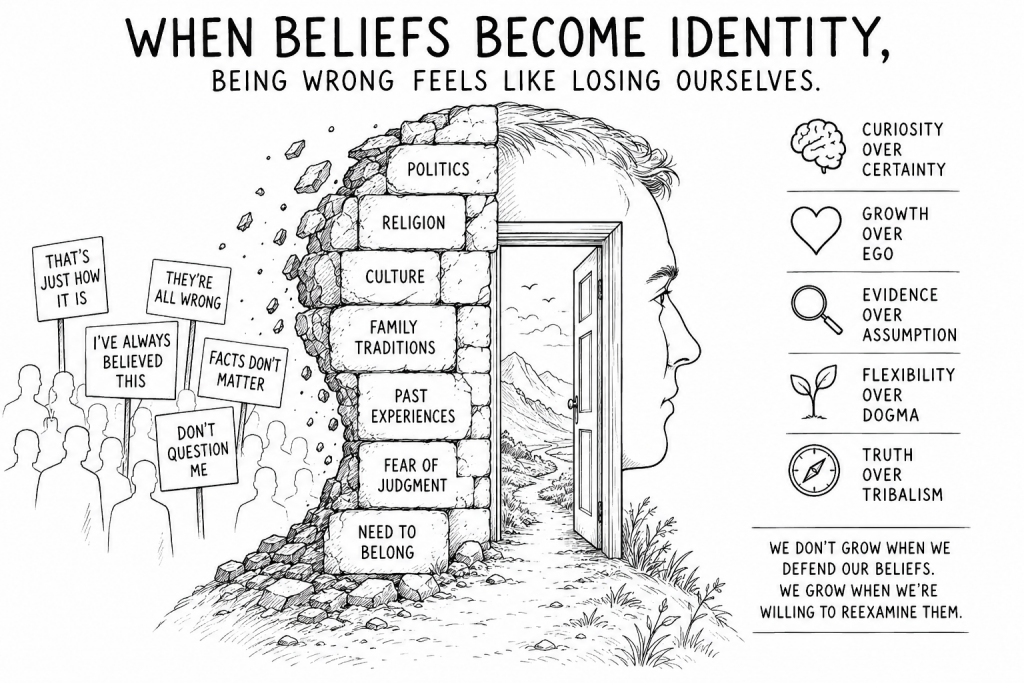
Beliefs Are More Than Ideas
Many of our beliefs begin as opinions. We gather information, form conclusions, and navigate the world accordingly.
Over time, however, some beliefs become intertwined with our sense of self.
They stop being things we think and start becoming things we are.
A person may no longer simply believe in a political ideology—they become a conservative, a liberal, a libertarian, or a progressive. Someone may no longer simply practice a religion—they become a Christian, Muslim, atheist, or Buddhist. A parent may stop viewing themselves as someone who made a particular parenting choice and instead become “the kind of parent who would never do that.”
When beliefs become identity markers, changing them feels less like learning and more like self-destruction.
The Psychological Cost of Being Wrong
When evidence challenges a deeply held belief, people often experience what psychologists call cognitive dissonance: the discomfort that arises when our beliefs and reality appear to conflict.
There are two primary ways to reduce this discomfort:
- Change the belief.
- Reject, reinterpret, or minimize the conflicting evidence.
The first option sounds simple, but it can be emotionally expensive.
If a belief is central to who we think we are, admitting it may be wrong can trigger feelings of embarrassment, shame, regret, or even existential uncertainty.
This is why people sometimes double down on beliefs despite overwhelming evidence to the contrary. The issue is often not a lack of intelligence. It is self-preservation.
The brain is trying to protect a coherent sense of identity.
Communities Reinforce Beliefs
Human beings are social creatures. We do not develop beliefs in isolation.
Our families, friend groups, religious organizations, political communities, and online spaces often reinforce specific worldviews. These communities provide belonging, validation, and emotional safety.
Changing a belief may not simply mean changing one’s mind.
It may mean risking rejection from a tribe.
For many people, the unconscious calculation is straightforward:
“If I admit I was wrong, who will I become, and who will still accept me?”
The fear of social loss can be more powerful than the desire for factual accuracy.
Intelligence Is Not Immunity
One of the most fascinating aspects of false beliefs is that intelligence does not necessarily protect against them.
Highly intelligent individuals are often exceptionally skilled at constructing arguments that defend existing beliefs. They can become experts at explaining away contradictory evidence rather than examining it.
In other words, intelligence can sometimes help us rationalize our biases instead of overcoming them.
The issue is rarely the ability to think.
It is the willingness to question ourselves.
Identity Flexibility
People who are most capable of changing their minds tend to have something in common: they separate their identity from their beliefs.
Instead of saying, “This belief defines me,” they say, “This is my current understanding.”
That distinction creates psychological flexibility.
When new evidence emerges, they do not experience correction as a personal attack. They experience it as growth.
Being wrong becomes an opportunity rather than a threat.
The Courage to Reevaluate
Perhaps one of the most overlooked forms of courage is the willingness to examine our own assumptions.
It takes courage to ask:
- What if I’m mistaken?
- What evidence would change my mind?
- Am I defending the truth or defending my identity?
- Have I become emotionally attached to being right?
These questions are uncomfortable because they require humility. Yet they are often the doorway to wisdom.
Final Thoughts
The goal of life should not be to never be wrong. That is impossible.
The goal should be to remain teachable.
Every one of us holds beliefs that are incomplete, inaccurate, or entirely mistaken. The challenge is not eliminating error; it is creating an identity that can survive discovering it.
After all, growth rarely happens when we defend who we were yesterday.
Growth happens when we are willing to become someone new today.
Leave a Reply